

Twelve bio examples you can model, a fill-in template, and the part nobody covers: how your bio decides whether a buyer, and the AI they asked first, picks you.
Your bio is the most-read and least-worked thing you own.
A buyer who gets your name reads it before they call.
A referring agent reads it before they send anyone. And now there is a third reader that got to you first: the AI assistant the buyer asked before they ever typed your name.
A real estate agent bio used to be a formality you wrote once and forgot. It is now the single asset that decides whether you get chosen, and whether you get recommended at all. If you have read our piece on why AI doesn't recommend you, this is the asset it keeps checking.
This is the guide I wish more agents had read. Real examples you can model, a template you can fill in today, and the one thing every other bio guide leaves out.
What a real estate agent bio has to do in 2026
A good bio does one job: it makes it obvious, in ten seconds, why you are the right agent for a specific person in a specific market.
It has two readers now.
The buyer or seller, who wants to feel you understand their situation.
And the AI assistant, which reads your bio to decide whether it can confidently name you when someone asks who is best in your area.
Here is the whole thing in one sentence: a bio that works states who you help, where you work, the proof that you are good at it, and one human detail that makes you a person instead of a headshot. Everything below is how to do that well.
The anatomy of a bio that gets chosen
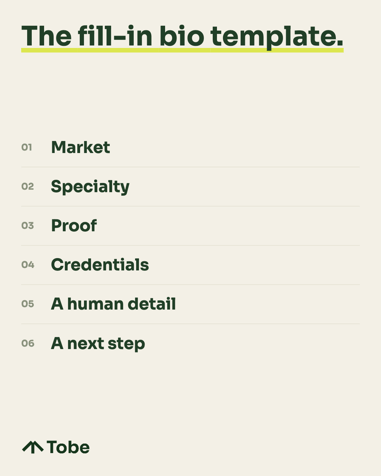
There are six parts to writing an AI-ready bio. Miss the first three and you sound like every other agent.
- Market. The specific place you serve. Not a state, a neighborhood or a niche. Specific is memorable and specific is what AI can match.
- Specialty. The kind of client or property you are known for: luxury listings, relocations, first-time buyers, investors, downsizers.
- Proof. A number. Homes closed, years in the market, volume, days on market, or a client outcome. Proof is what separates a claim from a fact.
- Credentials. Designations, awards, or a prior career that transfers. Include them plainly so a machine can read them, not buried in a paragraph.
- A human detail. One true, specific thing. You coach little league, you restored a 1920s bungalow, you moved here yourself. This is what makes people trust you.
- A next step. What to do now. Call, book a consult, download the neighborhood report. A bio with no next step wastes the attention it earned.
12 real estate agent bio examples that get you chosen
These are model bios by agent type. Swap in your real market, numbers, and voice. Each one leads with market and specialty, backs it with proof, and ends like a person. After each, what works and what I would change, because most bios are one small fix away from good.
1. The hyperlocal expert
Maria sells homes in Sugar House and nowhere else. She has closed 40-plus homes within a mile of Fairmont Park in the last three years, tracks every new listing on the block, and can tell you which streets hold value and which ones flood. If you are buying or selling in Sugar House, you want the specialist, not a generalist passing through.
Why it works: Names a specific market and backs it with a number. A buyer and an assistant both understand exactly what she does and where.
What I would change: Add one review quote or designation so an outside source corroborates the claim.
2. The luxury listing specialist
David represents architecturally significant and view properties above two million on the east bench. Over eighteen years he has sold more than 300 million in homes, and he markets each listing like a brand, not a flyer: professional film, private previews, and a buyer network built one relationship at a time.
Why it works: Price band, property type, and a hard proof number make it instantly clear who he is for.
What I would change: One sentence on a specific sale or a named recognition would give AI a citable fact.
3. The relocation and feeder-market pro
Priya helps California and New York buyers land softly in the Wasatch Front. She knows the tax reasons people move here, which neighborhoods fit a remote executive versus a growing family, and how to buy a home you have only seen on a screen. Most of her clients close before they ever move.
Why it works: Feeder markets are load-bearing for luxury and relocation. Naming them makes her findable for a very specific search.
What I would change: A number (relocations closed, or years) would turn a strong story into proof.
4. The brand-new agent (no sales yet)
Sam is a first-year agent in Provo backed by [Brokerage] and a decade in project management, where he ran six-figure builds on deadline and budget. He is new to real estate, not to negotiating, coordinating trades, or keeping a stressed client calm. He answers his phone, he does the homework, and he treats your timeline like his own.
Why it works: Borrows proof from a prior career instead of apologizing for being new. This is the hardest bio to write and the most valuable when done right.
What I would change: Nothing to cut. Add a designation or training the moment you earn one.
5. The first-time-buyer guide
Ana helps first-time buyers in the Salt Lake Valley go from I have no idea where to start to keys in hand. She explains every step in plain language, has closed more than 60 first homes, and is comfortable being asked the same question three times. Nervous is normal, and she has done this a lot.
Why it works: Speaks directly to the emotional state of the buyer and pairs it with a proof number.
What I would change: A line about down-payment programs she knows would add a concrete, searchable specialty.
6. The investor specialist
Marcus works with buy-and-hold and small multifamily investors across the metro. He underwrites a deal the way you do, on the numbers, and will talk you out of a bad one. He has closed 120-plus investment purchases and manages relationships with lenders and contractors who move fast.
Why it works: Names the buyer type and speaks their language. Investors want a peer, not a cheerleader.
What I would change: One example metric (average cash-on-cash, or a portfolio built) would sharpen the proof.
7. The career-changer
Before real estate, Elena spent fifteen years as a labor-and-delivery nurse, which is to say she is calm in a crisis and honest when it matters. She has sold homes across the south valley for six years and brings the same care to a nervous seller as she did to a nervous new parent. Her clients tend to become repeat clients.
Why it works: Turns a prior career into a trust signal instead of a footnote. Memorable and human.
What I would change: Add closed-volume or a review to pair the story with proof.
8. The team lead
The Harper Group is a five-person team serving the north metro, led by Kate Harper, who has personally closed over 500 homes. The team means someone is always available, a dedicated listing coordinator, a buyer specialist, and a marketing lead, so nothing falls through the cracks on the biggest transaction of your life.
Why it works: Explains the value of a team clearly (availability, specialization) and anchors it to a named leader with a number.
What I would change: Make sure the leader's individual credentials are stated, so AI attaches authority to a person, not just a group.
9. The bilingual, community-rooted agent
Carlos has helped Spanish-speaking families buy and sell across West Valley for nine years, guiding first-generation buyers through a process no one in their family has done before. He closes in either language, knows the lenders who understand these buyers, and shows up at the same community events his clients do.
Why it works: A genuine specialty that is also a real search. Community roots are proof of trust.
What I would change: A number of families served, plus any lender partnerships named, would strengthen it.
10. The data-and-marketing agent
Ben sells homes with better marketing and fewer surprises. Every listing gets professional media, a pricing analysis you can actually read, and weekly reporting so you always know where things stand. He has averaged 4% over list on his last twenty sales and will show you the math before you sign.
Why it works: Differentiates on process and backs it with a specific, verifiable outcome.
What I would change: Cite the source of the over-list figure (last twenty sales) so it reads as data, which it does here.
11. The downsizer and senior-move specialist
Susan helps longtime owners sell the family home and move on to the next chapter. She coordinates the whole thing, stagers, movers, estate sales, and the paperwork, at the pace the family needs, not the market's. Over twenty years and 400-plus sales, she has learned this move is about more than a house.
Why it works: Names an underserved, emotionally specific niche and pairs it with deep proof.
What I would change: Nothing to cut. A single client quote would make it unforgettable.
12. The referral veteran
For twenty-two years, almost all of Jim's business has come from past clients and their referrals, which tells you most of what you need to know. He has closed over 700 homes across the valley, still writes the offer himself, and answers to you, not to a call center. If someone you trust sent you here, this is why.
Why it works: Turns a referral-based practice into a stated proof of trust. The number does the rest.
What I would change: Add where AI can verify him (Zillow reviews, a press mention) so the referral reputation shows up online too.
The fill-in template
Copy this, replace the brackets, and you have a working bio in ten minutes. Read it out loud when you are done. If it sounds like a person, keep it.
[Name] helps [who you help] [buy or sell] in [market or neighborhood]. [Proof: homes closed, years, volume, an outcome, or a specialty]. [Credential, designation, or transferable prior career]. [One true, human detail]. [Clear next step: how to reach you or what to do next].
What to write when you are brand new (or have no sales yet)
New agents freeze on the bio because the proof section feels empty. It is not.
You just borrow proof from somewhere else. Lead with your market knowledge, your prior career, your training, and the standard you hold yourself to. See example four above for the shape of it.
Two rules. Never apologize for being new, and never pad with fluff like passionate or dedicated, which every agent claims and no reader believes. State plainly what you bring and who you help. The moment you close your first home or earn a designation, it goes in.
Your bio is different on every platform
Same facts, different length and tone, in each place a buyer or an assistant looks. Your website carries the full version. Your Zillow and Realtor.com profiles lead with proof and reviews, because that is what those readers came for. Instagram gets one human line and a link. LinkedIn gets the credential-forward, professional version.
The trap is letting them drift. A different specialty on Zillow than on your site, an old brokerage on one profile, a nickname on another. To a person that is sloppy. To an assistant it is a contradiction, and contradictions are exactly what make AI hesitate. Vary the length and the voice. Keep the core facts identical.
The part nobody tells you: how your bio gets you recommended by AI
When a buyer asks an assistant who the best agent in a market is, it does not read your mind or your reputation. It reads your bio, on every profile it can find, and looks for a consistent, verifiable story. That is why the bio is the quiet center of getting recommended by AI: it is the owned-content leg of what we call the trust stack, the thing every other source gets checked against. It is also the foundation everything in our SEO for realtors work builds on.
So write it to be verified, not just admired. State your market, specialty, and credentials plainly, in words a machine can match. Keep them identical across your website, Google Business Profile, Zillow, Realtor.com, and LinkedIn. When those agree, the assistant reads one confident agent and is comfortable naming you. When they disagree, it names someone clearer.
One fact makes the stakes concrete. In our own tracked measurement of AI answers about real estate marketing, the single most-cited source appeared in about a third of the answers, while ranking only 26th in Google for the same topic. AI citation and Google ranking are different games. Your bio, made consistent and specific, is where an agent starts winning the first one.
Frequently asked questions
How long should a real estate agent bio be?
Two versions. A full bio of about 150 to 300 words for your website, and a short one of two or three sentences for Zillow, Instagram, and directory profiles. Lead with market, specialty, and proof in the first two lines either way, because that is what gets read.
How do I write a real estate bio with no experience?
Borrow proof from elsewhere: your market knowledge, a prior career, your training, and the standard you hold. State plainly what you bring and who you help, never apologize for being new, and skip filler words like passionate. Add your first sale and any designation the moment you earn them.
Should I write my bio in first person or third person?
Third person on your website and directory profiles, because it reads as more established and is how portals format them. First person works on Instagram and in a personal note. Pick one per platform and be consistent; do not switch mid-bio.
What should a new real estate agent put in their bio?
Your market, the clients you want to serve, your brokerage, any transferable prior experience, your training, and one human detail. Proof of effort and standards stands in for a sales record until you have one.
Does my bio affect whether AI recommends me?
Yes. Your bio is a primary source AI reads to decide who you are and whether to name you. A clear, specific bio that is consistent across your profiles makes you easier to verify and recommend; a vague or contradictory one makes the assistant hesitate.
Should my bio be the same on Zillow, Instagram, and my website?
The core facts (name, market, specialty, credentials) should be identical everywhere, because consistency is what lets AI confirm you. The length and tone should change by platform: full on your site, proof-forward on Zillow, one human line on Instagram.
Get your bio, and everything AI reads, working
A great bio is the first move. The next is making sure it agrees with every other place AI checks. If you want to see how you show up right now, our free Real Estate AI Visibility Checklist walks you through the exact signals AI reads, so you can check where your bio and profiles line up and where they break. If you want the full picture with your top competitors side by side, that is the AI and Search Intelligence Blueprint. And when you want it handled for you, our SEO for realtors engagement does the work on top of whatever site you already have. Either way, you keep the fixes.
Waste less. Grow smarter.