

A few months ago a client asked me a question I could not answer: "Andrew, how do I make sure I show up when someone searches for a luxury agent in my market on ChatGPT?" At the time, honestly, nobody in the industry had a clean answer. So I went and built one. My agency spent the better part of two years running AI-visibility audits for real estate agents, and what we found changed how I think about SEO for realtors entirely.
The referral used to be the end of the discovery process. Now it is the beginning. Someone gives a buyer or seller your name, and the very first thing they do is ask AI about you. If AI does not know you, or describes you wrong, you often do not even get the interview.
That is the uncomfortable shift. For twenty years, SEO for realtors meant ranking on Google. It still means that. But it now also means being the agent that AI recommends, and those are not automatically the same thing.
SEO for realtors did not die. It moved into the AI answer.
The skepticism is fair. The conclusion is backwards.
There is real skepticism in this audience, and it is earned. I have seen the Reddit threads asking whether there is any point in trying to rank at all anymore. Google got crowded. AI Overviews sit above the links. It feels like the ground moved.
It did move. It did not disappear. Roughly 37% of searches now start with an AI tool instead of a traditional search engine. Google has built Gemini directly into Maps, so a buyer can ask a full question and get a conversational answer pulled from live Maps data. The pins and the links still exist. Fewer people want to wade through them.
The takeaway for an agent is not "SEO is dead." It is the opposite. The fundamentals that earn traditional rankings are the same fundamentals that make you citable by an assistant. The work matters more now, not less.
Your affluent buyers and sellers are already asking AI
This is not hypothetical, and it is especially not hypothetical for luxury. According to realtor.com (October 2025), 82% of Americans actively buying or selling now use AI for real estate insights. Not 82% of everyone. 82% of the people in the market right now, which is to say your clients and your prospects.
Around 74% of households earning $100,000 or more use AI in their searches. The luxury and mass-affluent buyer over-indexes on exactly the tools that read the open web: Perplexity usage runs about 30% above average for this group, and LinkedIn about 15% above.
The platforms are moving too. Zillow signed a data partnership with ChatGPT in October 2025, and Redfin followed in February 2026. So when a referral hands your name to an affluent buyer, they go ask AI about your history, your track record, and your specialty before they ever call. If the answer is thin or wrong, the call may never come.
Why your listings don't show up: AI has to corroborate you
Here is the mechanic that explains almost every invisible agent we audit. Old-school SEO read your website and mostly stopped there. AI does not stop. It reads your site, then it goes out and checks that story against Zillow, Redfin, your Google Business Profile, and the directories. This is corroboration.
If AI cannot corroborate what your website claims, it will not confidently recommend you. Worse, it may describe you inaccurately or invent details, which for a name-brand agent is its own kind of damage.
And this is the line I want every agent to sit with: AI recommends the clearest signal, not the highest producer. If your digital presence is the most specific and consistent about your market and your expertise, you can be surfaced ahead of the number-one producer in your market whose profiles are generic. That gap is an opportunity, and right now it is wide open.
The four signals that decide whether AI recommends you
Across hundreds of audits and more than a hundred roadmaps, the pattern held. Four signals do most of the work.
Signal 1: Your entity footprint (name, address, phone number)
The most boring and most common failure. Your name, address, and phone number have to match exactly everywhere you exist online: your website footer, your Google Business Profile, Zillow, realtor.com, and the rest. We found roughly 13 directories that AI treats as authoritative, and most agents are listed on only four to six of them.
Old brokerage addresses, a stale phone number, "Ste 100" on one profile and "#100" on another. Each of those is a small reason for AI to lose confidence. Start from the address registered with your Secretary of State and make everything consistent. If you hold licenses in two states, this is where same-as schema (a bit of code on your site) tells AI that the two profiles are the same person, licensed and producing in both markets.
This is the lowest-hanging fruit, and in less competitive markets, tightening it alone can move results.
Signal 2: Review authority
Reviews do double duty. They help you surface in the answer, and they are what tips a maybe into a call. From our audits, roughly 30 Google reviews is the threshold for AI consideration in most markets, closer to 50 in highly competitive ones, with another step up around 100. It is not only Google. Zillow and realtor.com reviews count too.
Two things most agents miss. The reviews themselves are keyworded, so a seller review that mentions your process and getting top dollar is gold. And your replies are keyworded too, so reply in the language of your market ("it was a pleasure being your luxury agent in Scottsdale"). If you have been shy about asking, this quarter is the time to build the habit.
Signal 3: Content authority
A thin site is a dead end. If all you have is a bio and an IDX listings widget, AI has nothing to corroborate against. The agents who win publish content that proves expertise: market reports turned into indexable web pages (not PDFs, which AI cannot read well), deep neighborhood guides, a clear explanation of your seller process, and FAQ content that answers what buyers and sellers actually ask.
If you are an Institute member, your market reports are among the most underused assets you have. The Wall Street Journal quotes that data. Publish your take on it as a page, not an emailed PDF, and you hand AI a reason to treat you as the authority.
Signal 4: Specialty clarity (brand is the moat)
"I am proactive, I get top dollar, I am a top producer." Every agent says it, which means it says nothing. In an age of generic AI-written content, a clear brand is one of your only moats, because AI is looking for a specific, corroborated reason to recommend one agent over another.
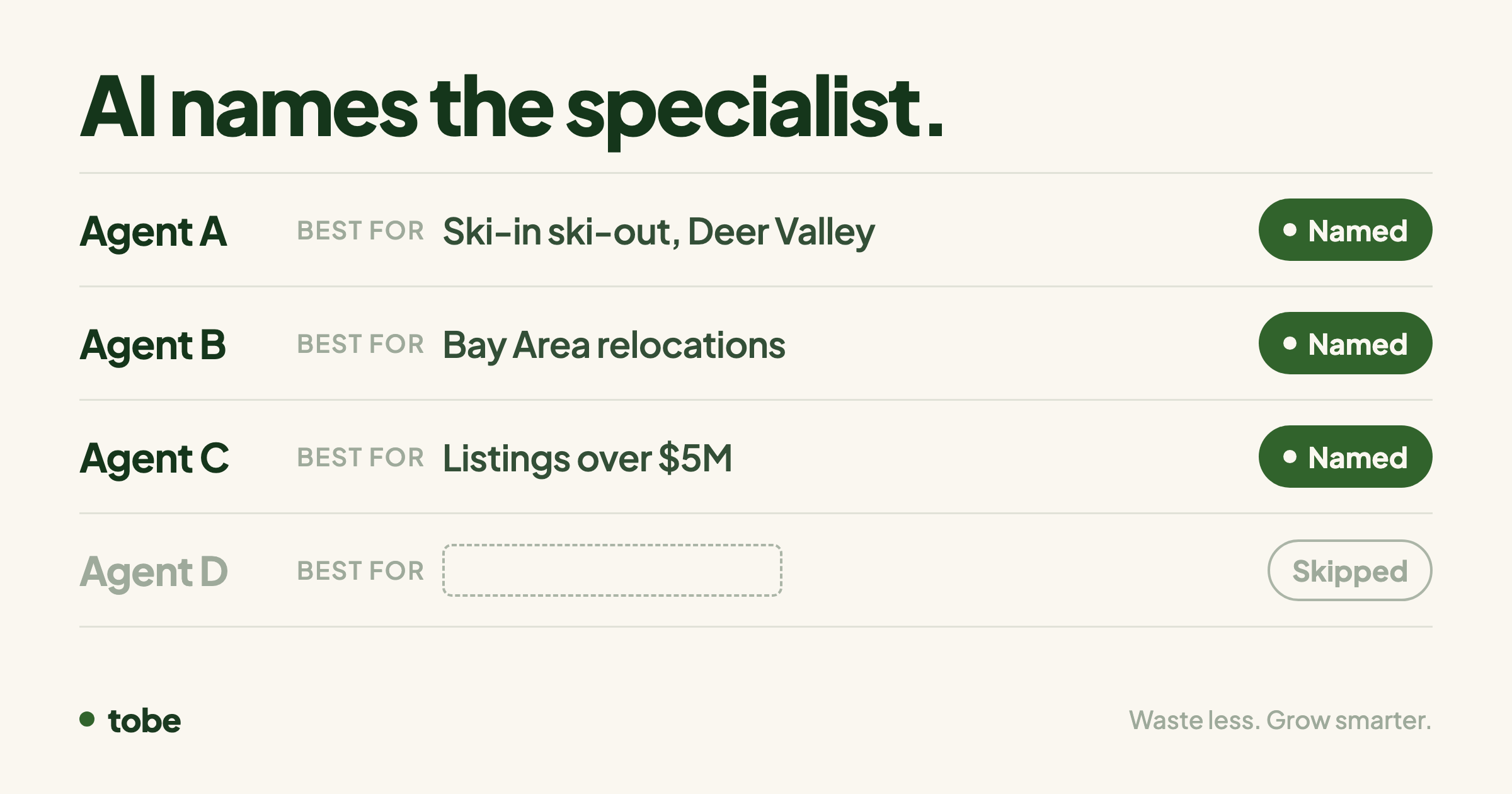
Get granular. Name your property types, your feeder markets, your buyer. "I help Californians relocate to Wyoming for the tax advantages of a second home" is a signal. "Luxury specialist" is noise. If you stumble when asked why a seller should choose you over the agent down the street, that is the work. The StoryBrand framework is a fast way to force the specifics out.
What this looks like in a real audit
Here is one anonymized example: an established luxury team, more than twenty years in the market, around $300 million in annual sales. When we ran their AI visibility, they appeared in only one of four AI platforms. They were listed in just four of the 13 directories. They had eight Google reviews; their top competitor had 43. Their website had no market reports, no seller resources, and no FAQ content, and their Google Business Profile had not been updated in 14 months. One AI described this $300 million team as a "consulting firm" and did not mention them by name for the category search at all.
The reputation was real. The production was real. The internet could not corroborate any of it, so the AI could not either. That is the gap, and it is a signaling problem, not a talent problem.
Will AI replace realtors?
No. But agents who are invisible to AI will lose to agents who are not. AI is changing how clients find you and vet you, not whether they need you. Treat it the way the early winners treated SEO fifteen years ago, and the arbitrage is yours while most of your market is still asleep on it.
If you are here, start here
If you get steady referrals but they "check you out" and go quiet, your digital presence probably does not corroborate your reputation. Fix the entity footprint and the reviews first.
If you rank fine on Google but feel invisible in AI answers, your content and your reviews are not yet citable. Publish the market reports and the neighborhood depth.
If you are a strong producer with a thin website, you do not have a production problem. You have a signaling problem, and it is the fastest of all to fix.
FAQ
Does SEO still work for real estate agents in 2026?
Yes, more than ever. It just changed shape. Traditional rankings still matter, and the same fundamentals (a clean profile, strong reviews, real content) are exactly what make you visible inside AI answers. SEO for realtors did not end. It expanded to include being the agent AI recommends.
Will AI replace realtors?
No. AI is changing how buyers and sellers find and vet agents, not whether they hire one. The risk is not being replaced by AI. It is being invisible to it while a competitor is not.
How do buyers find agents and homes now?
Increasingly by asking an AI assistant (ChatGPT, Gemini, Perplexity, or Google AI Overviews) a plain-language question, then judging you in seconds from your profile and reviews. The referral now leads to an AI search, not away from one.
How do I get my listings and agent profile to show up in ChatGPT, Perplexity, and Google AI Overviews?
Make yourself easy to corroborate: consistent name, address, and phone number across the authoritative directories, strong recent reviews, a content-rich website, and same-as schema. AI recommends the clearest, most consistent signal.
What is AI search (GEO) for real estate agents?
GEO, generative engine optimization, is structuring your digital presence so AI platforms can find you, understand you, and recommend you. GEO is to AI search what SEO was to Google, and good SEO is the prerequisite for good GEO.
How do I actually do SEO as a realtor?
Start with the four signals: fix your name, address, and phone number across every directory, build reviews toward the 30-plus threshold, publish real market and neighborhood content, and sharpen your specialty. A visibility audit tells you which one is your biggest leak.
Is real estate SEO worth it for agents?
For agents who serve self-researching, affluent clients, yes. Those buyers start in AI, and AI reads the open web. The agents who invest now capture a gap most of their market has not noticed.
Find out what AI actually says about you
You do not have to guess. Our free Realtor AI Visibility Audit shows you whether you are cited when buyers ask AI about agents in your market, across the major platforms, and where your gaps are.
If you want the full picture, the $999 AI & Search Intelligence Blueprint gives you a 60-plus page diagnostic and a prioritized six-month roadmap your team can execute.
Waste less. Grow smarter.