

Ask what a real estate agent website costs and you will get a range wide enough to park a house in. One article says $3,000 to $15,000. Another calls $4,000 to $12,000 typical. A third stretches from $2,000 to $45,000. I just had this conversation with another agency owner the other day.
All of them are technically true, and none of them answer the question you are actually asking: what does the money buy?
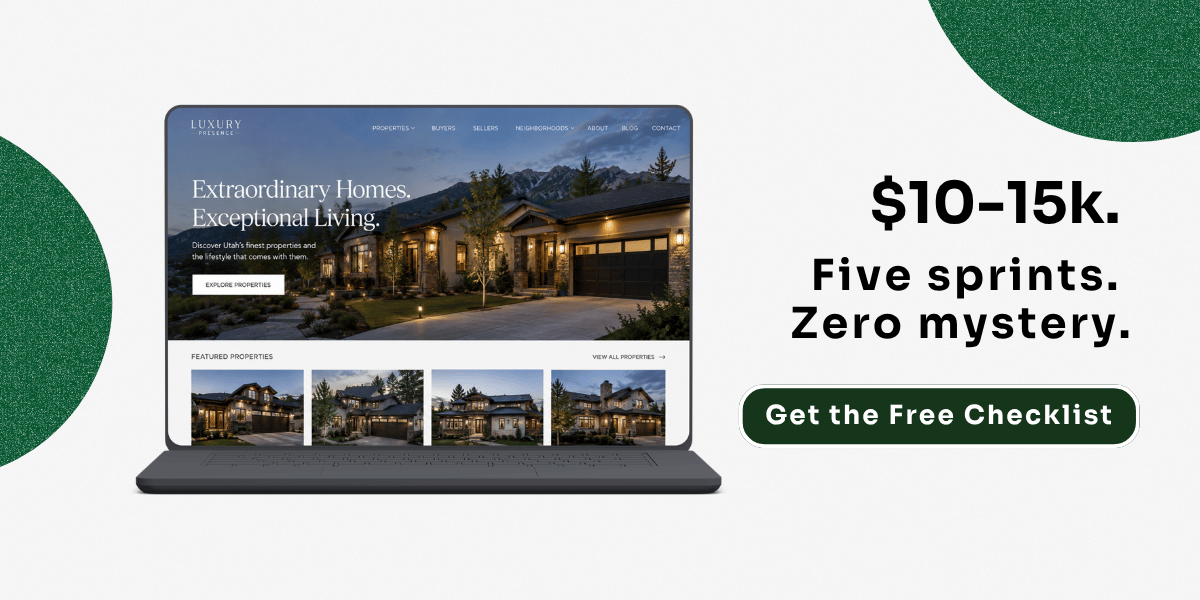
We think the range is the problem. So here is the answer nobody publishes. Our AI-search website sprint for real estate agents runs $10,000 to $15,000, and this article lists exactly what that buys, sprint by sprint.
If you are comparing quotes for a real estate agent website right now, hold every quote, including ours, against this list.
One thing before the line items. 99% of home buyers use the internet in their home search (NAR, verify link at publish).
The question is no longer whether buyers find agents online. It is whether what they find, increasingly through ChatGPT, Gemini, and Google's AI answers, is a website those systems can read and recommend.
That layer is the difference between this scope and the feature checklists in every cost article, and it is why we call it an AI-search website.
Why website pricing is vague on purpose
A range is easy to defend and impossible to compare. That is why every cost article publishes one. The honest version of the market looks like this: template and DIY platforms run a few hundred to a few thousand dollars a year, custom agency builds run $3,000 to $15,000 with $4,000 to $12,000 as the typical band, and IDX integration alone adds $1,500 to $5,000.
Our band sits at the premium end of custom, and the rest of this article is the reason why.
Because here is what the ranges hide: the difference between a $5,000 build and a $12,000 build is rarely the design. It is what is underneath the design, and whether anyone thought about the machines reading it.
What is an AI-search website?
An AI-search website is a site built so AI platforms can find you, understand what you do, and confirm it from other sources. In practice that means structured data on every page, consistent identity details across the web, neighborhood content specific enough to cite, and third-party proof like reviews and citations. The design your buyers see sits on top. The machine-readable layer sits underneath.
Your buyers already work this way.
When they ask an AI who to hire or what to know about a market, the answer is assembled from whatever those systems can read and verify. We covered why listings alone do not surface in those answers in our guide to seo for realtors, and what to do when you already have a site you like in our piece on real estate agent seo.
This article is for the third situation: you need a new site, and you want it built for the way buyers search now.
Real estate website design is the visible half
Most real estate website design conversations are feature checklists: IDX search, a CRM hookup, a mortgage calculator, beautiful listing pages. Those matter, and they are in our scope too.
But a feature checklist treats the website as the whole product, and it is only half. Design converts the buyer who arrives. The layer underneath decides whether anyone gets sent to you at all. A build that stops at design is a store with great fixtures on a street with no signs pointing to it.
Sprint 1: Brand and Messaging Foundation
What you get: a working session and a written messaging guide. Who you serve, where, at what price point, and the one story every page repeats.
Why it matters for AI search: AI recommends the clearest signal. When your homepage, your about page, your Google Business Profile, and your Zillow profile all tell the same story, machines treat it as fact. When they drift, you become unverifiable, and unverifiable does not get recommended.
What a template build skips: this step entirely. You get a theme and placeholder text, and the message stays in your head where no machine can read it.
Sprint 2: The Website Build
What you get: a roughly 20-page WordPress site on your own domain, built from about six custom page templates, with IDX integrated so listings live on your site. You own all of it.
Why it matters for AI search: architecture. Each page is built to answer one question well, which is the shape AI cites. And ownership compounds: every page you publish builds equity in an asset you control, not a platform you rent.
What a template build skips: the architecture and the ownership. On a rented platform your content builds someone else's asset, and if you leave, you start over.
Sprint 3: Neighborhood Authority
What you get: around five neighborhood hub pages, each a real guide to a market you work. Pricing patterns, housing stock, who is buying, what a buyer should know before they look.
Why it matters for AI search: when a buyer asks what to know about a neighborhood, AI cites the most specific, well-organized page it can find. In our tracking of how AI platforms answer real estate questions, local, specific pages like these are exactly what gets cited, while generic pages get skipped. This is the content a listings widget will never give you.
What a template build skips: local content entirely. Templates ship with the same pages for an agent in Boise as an agent in Boca.
Sprint 4: The AI-Search Layer
What you get: structured data (schema) on every page, a built-out Google Business Profile, and identity consistency, your name, brokerage, address, and phone matching everywhere they appear online. We help tie all of this together.
Why it matters for AI search: this is the machine-readable layer, how AI verifies you are real, what you do, and where you do it. It is the reason this is an AI-search website and not just a website.
What a template build skips: almost all of it. This layer is invisible in a sales demo, which is exactly why budget builds leave it out.
Sprint 5: Corroboration and Proof
What you get: citations built across the directories that matter, a review pipeline, a press release, and measurement checkpoints at Day 60 and Day 180.
Why it matters for AI search: AI does not take your website's word for anything. It trusts what independent sources confirm. Reviews, directory listings, and press are the third-party evidence that turns your site's claims into an answer AI will repeat.
What a template build skips: everything that lives off the site, which is most of what AI checks.
Not ready to price a build? Start smaller. When a referral checks you out on ChatGPT, what do they find? Our free Luxury Agent's AI Visibility Checklist is a 25-point self-assessment of the signals AI uses to recommend agents.
If you are here, start here
If you are pricing a build right now, take this list into every sales conversation and ask which sprints are in the quote. If a line item is missing, ask what replaces it.
If you already have a site you like, do not rebuild. The corroboration layer can be added on top of what you have; our real estate agent seo piece covers that path.
If you are not sure the site is the problem, start with the checklist above, or with the broader picture in our seo for realtors guide.
FAQ
How much does a real estate agent website cost in 2026?
Template and DIY platforms run a few hundred to a few thousand dollars a year. Custom agency builds run $3,000 to $15,000, with $4,000 to $12,000 typical, and IDX integration adds $1,500 to $5,000. Our AI-search sprint runs $10,000 to $15,000 and includes the AI-search and corroboration layers most quotes leave out.
What should a real estate website include to get found by AI?
Structured data (schema) on every page, consistent identity details across the web, neighborhood-specific content AI can cite, and third-party proof like reviews, citations, and press. Design converts visitors; these are what gets you into the answer.
Why does a template real estate website not show up in ChatGPT or Google AI Overviews?
Templates render attractive pages but usually skip machine-readable structure, local content, and off-site corroboration. AI cannot verify what the site claims, so it recommends an agent it can verify instead.
What is an AI-search website?
A website built so AI platforms can find you, understand what you do, and confirm it from independent sources. It adds a machine-readable layer (schema, entity consistency, citable local content, corroboration) underneath the design your buyers see.
Do I need IDX on my real estate website?
If you want buyers searching listings on your own domain, yes, and it is included in our build. But IDX alone is not a visibility strategy: the same feed appears on thousands of sites, so AI has no reason to cite yours. Pair it with original local content.
Is a custom real estate website worth it versus a template?
If you work a market where one transaction covers the build many times over, yes. You own the asset, and the AI-search layer compounds as the answers form. A template is a reasonable start for a brand-new agent who is not ready to invest.
How long does it take to build a real estate agent website?
Our build runs as five sprints over roughly a quarter [ANDREW: confirm timeline], with measurement checkpoints at Day 60 and Day 180 after launch, so you see what the site is doing, not just what it looks like.
Five sprints. One price. Zero mystery.
That is the whole scope: $10,000 to $15,000, five sprints, each one something you can point to and ask about. If you are comparing quotes, we are happy to be compared. See the full sprint breakdown and book a build consult on our SEO for Realtors page.
Waste less. Grow smarter.