

Sanibel Island has about sixty-five hundred year-round residents. The full service-area population swells with seasonal visitors, but on a normal Tuesday, this is a small island in Southwest Florida with one main road. Not a market most marketing playbooks were built for.
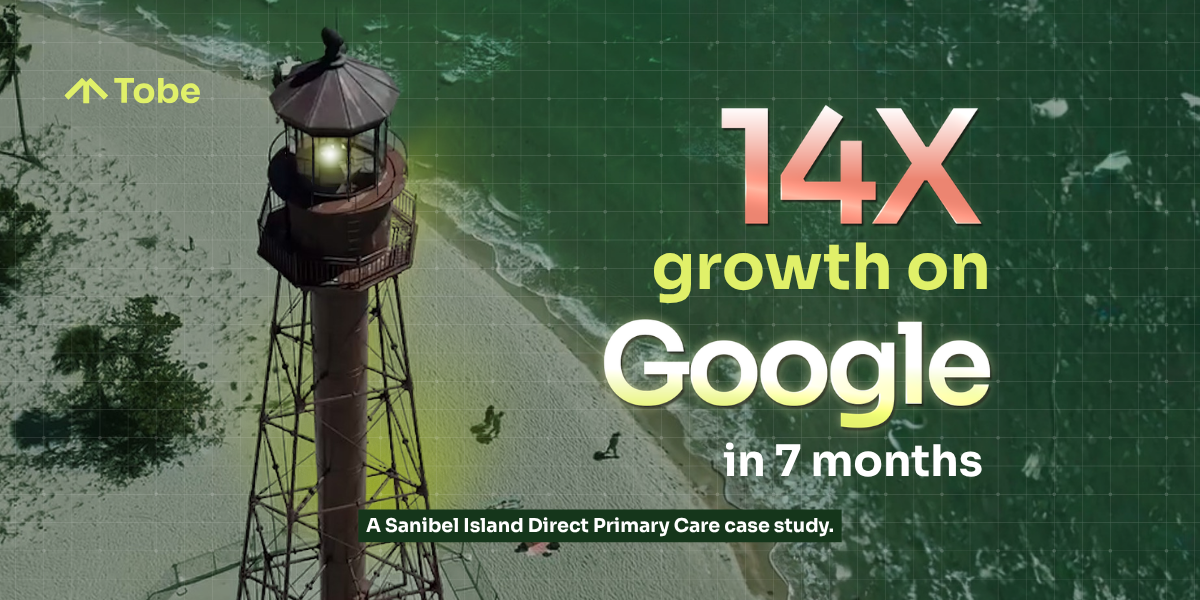
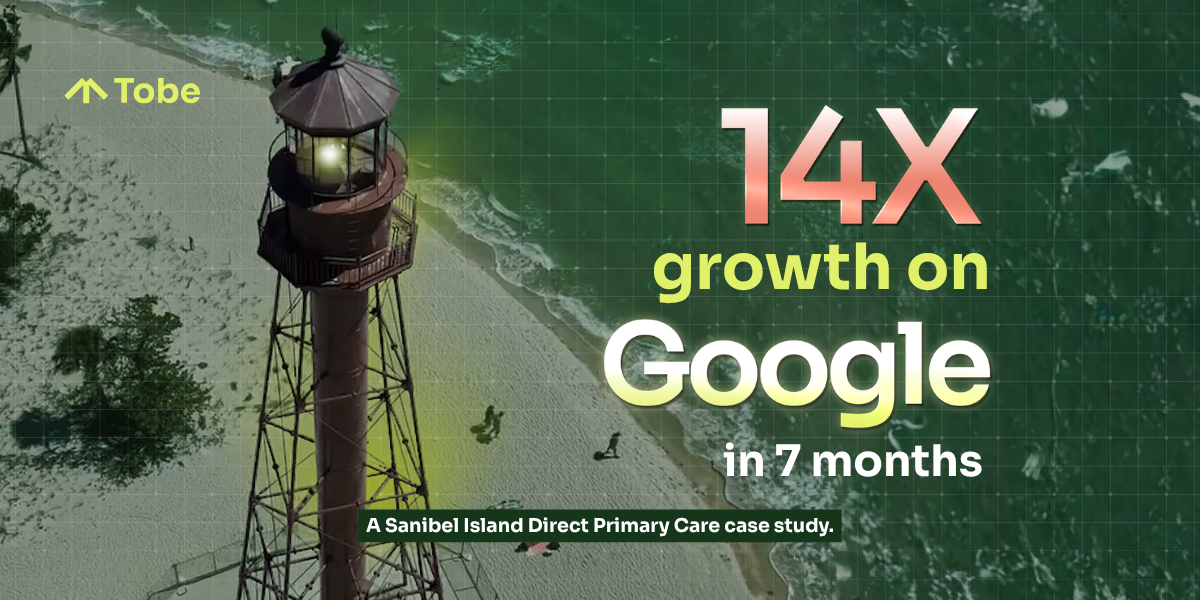
In October of 2025, a Direct Primary Care practice on the island had a Google Business Profile that registered 57 impressions for the month. By April of 2026, that same profile cleared 825 impressions, with 140 website clicks and 39 phone calls. That is 14× growth in seven months. No paid traffic. One sole nurse practitioner running the practice.
This is what early-stage local SEO actually looks like, before the trajectory plateaus. This is the case study.
Who the practice is
A Direct Primary Care practice on Sanibel Island, Florida, led by a single nurse practitioner. The model is cash-pay, no insurance, with memberships and executive physicals at the core. One provider sees every patient. The service area covers Sanibel, Captiva, Fort Myers, Cape Coral, Fort Myers Beach, and the broader Lee County corridor.
The math of marketing a practice like this is brutal. Paid ads at scale would break the schedule — there is only one provider on the chair. Mass-market healthcare SEO does not apply because the audience is a specific high-trust, high-LTV patient type. The total addressable market for the geography is tiny. The only marketing infrastructure that scales without breaking the practice is the one that makes the right patients findable at the right pace.
Where the practice started
A snapshot of the baseline in October 2025:
- GBP impressions per month: 57
- GBP website clicks per month: 3
- GBP phone calls per month: 0
- GBP direction requests per month: 0
- GBP categories listed: 1 (a basic medical clinic listing)
- GBP service items configured: 0
- Organic search tracking: none in place
A real clinic with a real provider was effectively invisible online for the markets it actually served.
What Tobe did
No always-on paid funnel. No creative campaign. Three pieces of infrastructure, done in the right order.
1. Rebuilt the Google Business Profile to operate as a real local-search asset
The profile expanded from one category to six: Medical Clinic, Endocrinologist, Wellness Center, IV Therapy Service, Urgent Care Center, and Weight Loss Service. Each additional category opened a new local-pack inventory the practice is now eligible for. Searches like "weight loss near me," "IV therapy near me," and "urgent care near me" did not surface this practice a year ago. Now they do.
Thirty-seven service items were configured. Service-area targeting was set across all six Lee County submarkets. The description was rewritten to clearly articulate the DPC, cash-pay, and executive physical positioning. The profile went from a placeholder to a real search asset.
2. Built a review reply discipline from the first review
Twelve lifetime reviews. Every single one at 5.0 stars. Reply rate: 11 out of 12. That is 92%. For a sole-provider practice with seven months of marketing activity, this is exactly the right pace. Volume is not the point at this stage. What compounds is each personalized reply, referencing the specific patient experience, signaling to Google that the practice is paying attention.
3. Used Meta surgically for events, not always-on conversion
In Q1 of 2026, a single Meta event campaign supported one in-clinic event. Spend: $225. Impressions: 10,096. Clicks: 394. RSVPs: 31. Cost per RSVP: $7.27. That is a precise tool used for one job, not a volume funnel running in the background. For a single-provider schedule, running an always-on paid funnel would break the practice faster than no traffic at all.
What changed
The compounding effect of doing the basics well shows up clearly in the data.
|
Metric |
Oct 2025 (start) |
Apr 2026 (now) |
Change |
|---|---|---|---|
|
GBP impressions / month |
57 |
825 |
14.5× |
|
GBP website clicks / month |
3 |
140 |
47× |
|
GBP phone calls / month |
0 |
39 |
New channel |
|
GBP direction requests / month |
0 |
31 |
New channel |
|
Organic search avg position |
No tracking |
~8 (page 1) |
Page 1 |
|
Lifetime reviews |
~10 (legacy) |
12 at 5.0★ |
Active velocity |
|
GBP review reply rate |
Sporadic |
92% |
Top-tier |
|
GBP categories |
1 |
6 |
+500% eligibility |
|
GBP service items |
0 |
37 |
Full inventory |
|
Meta event campaign |
n/a |
31 RSVPs at $7.27/RSVP |
New channel |
The monthly trajectory
The inflection point in the GBP data is unmistakable. October through January averaged about 70 impressions per month. February crossed 300. March passed 800. April held at 825 with the highest website-click count to date.
|
Month |
GBP Impressions |
Web Clicks |
Phone Calls |
Directions |
|---|---|---|---|---|
|
Oct 2025 |
57 |
3 |
0 |
0 |
|
Nov 2025 |
44 |
3 |
0 |
0 |
|
Dec 2025 |
64 |
2 |
0 |
0 |
|
Jan 2026 |
122 |
6 |
0 |
0 |
|
Feb 2026 |
300 |
33 |
4 |
9 |
|
Mar 2026 |
838 |
109 |
38 |
39 |
|
Apr 2026 |
825 |
140 |
39 |
31 |
Three results worth pulling out:
14× in seven months is what early-stage local SEO actually looks like. Most marketing case studies show year-two trophy results. This is the curve before it plateaus. For prospects asking "what should I expect in the first 90 days," this is the honest answer.
Two channels turned on from zero. Phone calls and direction requests both went from zero to active inside one quarter. A "Call" tap in Google Maps or Google Search is not traffic. It is a high-intent person one step from booking.
Paid did not do the heavy lifting. Across four months of site traffic, paid search produced 16 sessions out of 2,022 total. Ninety percent of all site traffic is organic and direct. The growth here came from infrastructure, not media spend.
What's next for the practice
The trend is still climbing. April broke into page 1 average position for the first time. May is on pace to sustain or surpass April's GBP volume, with organic search clicks projected to clear 250 for the month.
A few queries in the immediate queue:
- "doctor near me" in the Sanibel + Lee County service area (currently positions 7 to 8)
- "IV therapy" and "wellness center" queries in Fort Myers + Cape Coral spillover markets
- "urgent care near me" queries on the islands during seasonal traffic peaks
The flywheel is just starting to spin.
The takeaway
For a sole-provider practice, the goal of marketing is not volume. It is the right patients at the right pace. Local SEO and a real Google Business Profile deliver that without breaking the schedule. Meta is used surgically, for events, not as a permanent acquisition funnel that would bottleneck a single chair.
That happens through three things, done in order: a fully built Google Business Profile across every category and service you legitimately offer, a real review system inside your practice's daily intake, and surgical use of paid channels for moments where they earn their keep. The Grow Smarter Method is built around exactly this sequence.
Nothing in that playbook requires bigger ad spend. Most of it requires discipline.
If you run a sole-provider practice, a Direct Primary Care clinic, or a boutique specialty practice and you have been told you need to "scale paid" to grow, the gap is almost never paid budget. It is the foundational infrastructure that makes the right patients find you at the right pace. The Tobe healthcare local SEO page walks through how the playbook applies specifically to high-touch practices.
FAQ
How fast can a Direct Primary Care or boutique practice expect to see local SEO results?
For a sole-provider practice in a small to mid-size market, expect a curve like this one. Months 1 to 3 are profile rebuild and indexing. Months 4 to 6 are the first impression and click acceleration. Months 7 to 12 are when phone calls and direction requests come online in volume. The practice profiled here hit the call and direction-request acceleration around month 5, which is on the fast end.
Does this approach work for cash-pay or membership-based practices?
Especially well. Cash-pay and membership models depend on the right patient finding the practice at the moment they are ready. Local SEO and a strong Google Business Profile are precision tools for that exact moment. Volume-based paid funnels usually create more schedule friction than revenue for these practice models.
Why use Meta only for events, not always-on?
A single-provider schedule cannot absorb the volume an always-on paid funnel produces. Meta event campaigns are time-bounded, focused on a specific in-clinic moment, and easy to measure. The Q1 campaign profiled here produced 31 RSVPs at $7.27 each on a $225 spend. That is the right shape of paid for this kind of practice.
Want this for your practice?
Tobe takes on a small number of healthcare local SEO clients each quarter. If you run a sole-provider or boutique practice and want the foundational infrastructure done in the right order, book a free local SEO audit.
Waste less. Grow smarter.