


Inbound marketing is all about the buyer. For that reason, it’s imperative to understand the buyer’s journey. Today, most of this journey takes place online. With a firm grasp on the process by which a buyer seeks out, researches, and selects a product or service, you’ll be able to optimize your website and inbound marketing content for greater sales.
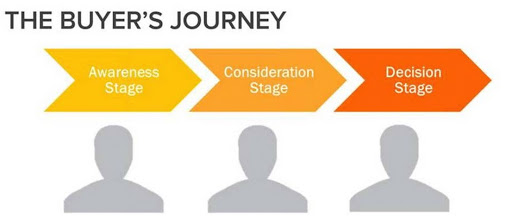
1. Awareness Stage
The first stage of the buyer journey occurs when the consumer has a need to fulfill or a challenge to solve. In relation to the sales funnel, the awareness stage correlates with the top of the funnel.
Let’s use an example. Michael is the regional manager of a small paper supply company. Due to a staggering increase in e-commerce sales, Michael has added two fulfillment centers. Recently, several large orders have been unexpectedly delayed due to incorrect inventory counts. Their old inventory management system is failing and Michael needs to find something that will help him track stock levels across all of his fulfillment centers.
Michael has now realized that there is a problem to solve. This is the beginning of the awareness stage. Michael asks his Assistant To The Regional Manager, Dwight, to hit the World Wide Web and start researching inventory solutions.
At this point, Michael isn’t even sure WHY his inventory system is failing to scale, let alone what potential solutions may exist. Educational content like blogs, white papers, and ebooks will help him understand what is required to manage complex inventories.
2. Consideration Stage
After Dwight presents the results of his online research, Michael begins to weigh his options. This is the consideration stage, which corresponds with the middle of the sales funnel.
Now Michael knows what kinds of solutions are available, and he needs to compare them. Michael will want to analyze the pros and cons of each approach and assess factors like cost, customer support, and long-term viability.
In the consideration stage, content like side-by-side comparisons, expert guides, client testimonials, and videos help potential buyers like Michael make an informed decision.
3. Decision Stage
The decision stage is the final step in the buyer’s journey, and occurs at the bottom of the sales funnel. At this point, the consumer will choose a product or service that solves their challenge.
As Michael enters the decision stage, he uses free trials and live demos to solidify his choice. Dwight will carefully look over case studies and product literature, just to be sure. Michael closes out the decision stage by selecting the inventory management software provider that best meets his needs. It’s no coincidence that he chooses the company that provided the most informative, helpful, and complete resources and tools.
While reading about the buyer’s journey, you’ve likely noticed the heavy reliance on content that supports the buyer at each stage. You’ll want to be sure that your website is inbound marketing-oriented and up to the task of guiding consumers like Michael from their earliest awareness research to their final decision.
If you could use some assistance in making sure your marketing is aligned with the buyer’s journey, don’t hesitate to reach out to the experts at Tobe. We’re kind of obsessed with this stuff!